Plaza:designing a retail tech ecosystem from the ground up
From 2 legacy applications to 9 integrated ones, used by retail chains worldwide.
- from 2 to 9
Applications: from 2 on-premise ones to 9 integrated in Plaza
Count · Application count - 2×
Stores using the SaaS, year over year, two years running
Measured · Plaza usage data across the client base - Best-in-class
How visitors described Plaza at NRF 2026, New York
Qualitative · Feedback collected at the Pricer stand

In shortPlaza is Pricer's platform for retail chains, built around electronic shelf labels. Clients asked Sales Engineers to run it for them, so I started in stores. Three design choices (one flow per feature, zero training, mobile first) and a shared design system turned 2 legacy applications into 9 integrated ones.
Start from a product that was SaaS on paper
Plaza was the on-premise server of the 1990s, containerised and moved to Google Cloud. The interface had been built by engineers for engineers: endless data tables, every option on screen for every user. Clients did not use it: they asked Pricer's Sales Engineers to run it for them. I audited the system, interviewed key clients, observed stores and used the product end to end.
Agree on three design choices
One best-practice flow per feature. Zero training. Mobile first. Each took months of conversations with product, engineering and management before it was accepted. To stakeholders used to “more features, more value” I showed what users needed.
Show people the features they need
Five principles run through the platform: relevance, cognitive unity, zero training, less flexibility, mobile first. The interface shows what each user needs by role and context, and the 9 applications share the same components and navigation patterns.
Build one design system for 9 apps
The design system, shared by all 9 applications, came with weekly design reviews with developers. I presented it as infrastructure that makes engineering faster, and that framing opened the door.
52% fewer component-related tickets · Measured · Ticket analysis with the dev team
Introducing design is first a communication job.
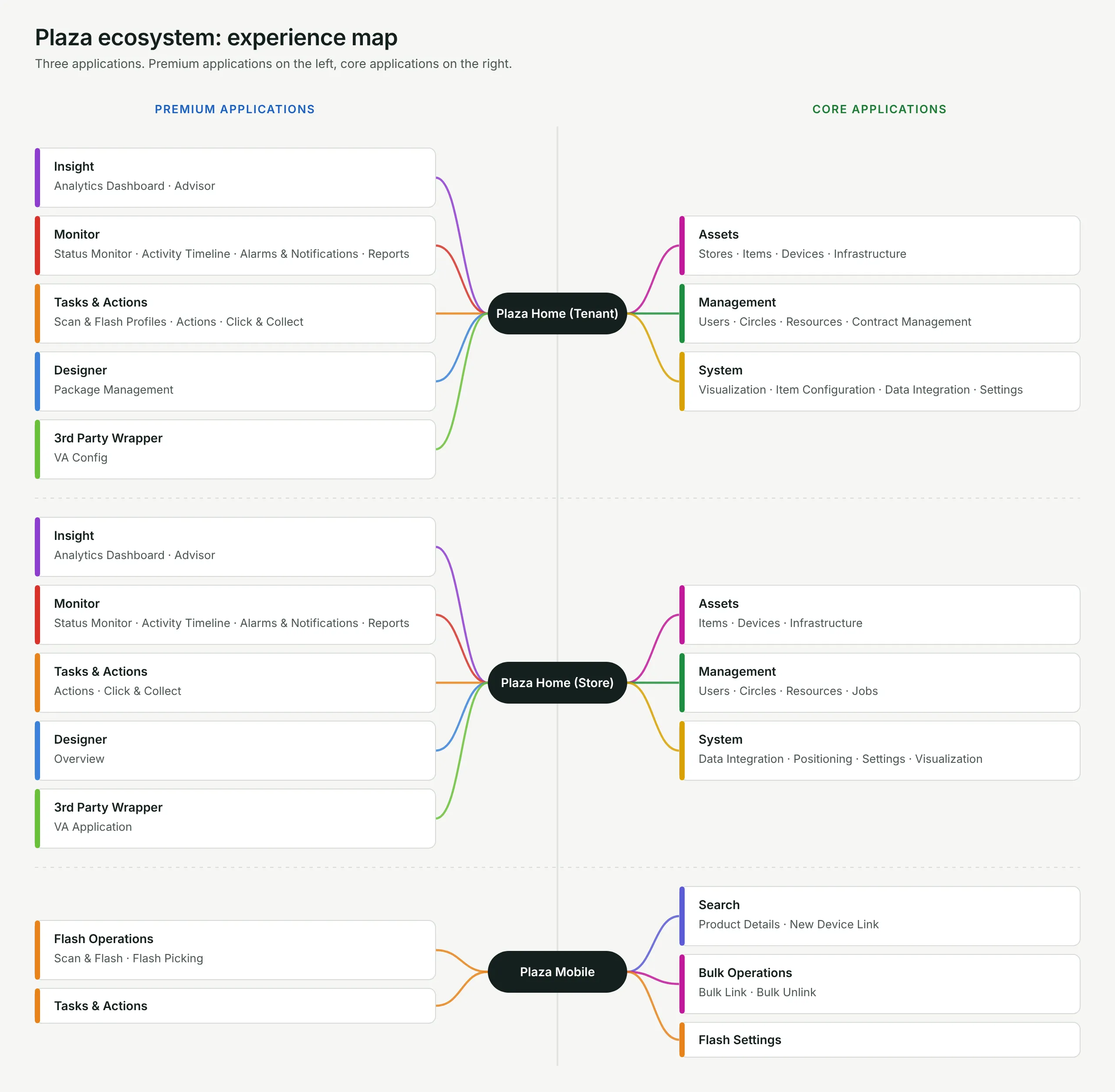
Text version: Plaza experience map
Three contexts. Plaza Home works in two of them, Tenant (the retail group) and Store; Plaza Mobile, a native app, stands on its own. Each context has premium and core applications.
- Plaza Home (Tenant). Premium: Insight (Analytics Dashboard, Advisor); Monitor (Status Monitor, Activity Timeline, Alarms & Notifications, Reports); Tasks & Actions (Scan & Flash Profiles, Actions, Click & Collect); Designer (Package Management); 3rd Party Wrapper (VA Config). Core: Assets (Stores, Items, Devices, Infrastructure); Management (Users, Circles, Resources, Contract Management); System (Visualization, Item Configuration, Data Integration, Settings).
- Plaza Home (Store). Premium: Insight (Analytics Dashboard, Advisor); Monitor (Status Monitor, Activity Timeline, Alarms & Notifications, Reports); Tasks & Actions (Actions, Click & Collect); Designer (Overview); 3rd Party Wrapper (VA Application). Core: Assets (Items, Devices, Infrastructure); Management (Users, Circles, Resources, Jobs); System (Data Integration, Positioning, Settings, Visualization).
- Plaza Mobile. Premium: Flash Operations (Scan & Flash, Flash Picking); Tasks & Actions. Core: Search (Product Details, New Device Link); Bulk Operations (Bulk Link, Bulk Unlink); Flash Settings.
Measure the design work
With the Product Owner I wrote user stories and the roadmap; with the product team I defined the OKRs. In my last year I introduced Google's HEART framework, and rapid prototyping in Figma with design system components from the first phase, to ease the handover to development. I designed the dashboards of Insight, the analytics application, to reduce human error, and ran a WCAG audit of the platform with the team.
Design the software for Pricer Avenue
Pricer Avenue is a shelf-edge platform with powered rails, modular electronic labels and dynamic displays, controlled through Plaza. I scoped the proof of concept with the Product Owner and took part in the workshops where the idea of a continuous canvas of joined labels emerged. I worked on the software: the part that spreads an image across the labels, the configuration and monitoring flows, the installation manuals. Avenue won the GOOD DESIGN® Award 2026; the award belongs to the product and the team.
“The best retail platform we've seen this year.”